
Fuelling and Hydration for Badwater 135
One of the most common questions I get about Badwater 135 is - what did you eat? The short answer is very little. Very little food, at least. The vast majority of my calories came from drinks and some gels. But let's break it down properly, and there is quite a bit of detail.
Heading into the race my main concern wasn't fuel, it was hydration - or more precisely, it was sodium. If you run low on carbohydrate you will slow down and you will suffer. Performance falls through the floor. If you run low on sodium it is serious. Very serious. It can be fatal.
We often hear that we are "mainly water", but we aren't a big bag of water. We are cells, billions of them, and each one holds water. If you can remember back to biology at school you might remember osmosis, the process by which fluid moves across cell membranes. I'm not going to pretend I know every transfer that takes place in the body, but there are a lot of them, and they all need the fluid on either side to be at the right concentration. The key player is sodium.
Here's a simple example you have probably experienced. Gulp down a load of water when you are thirsty and you can often feel it sloshing about in your stomach. Why isn't it being absorbed? You were thirsty, after all. Because it can't be, not straight away. Water needs sodium alongside it before it can start its journey across the gut wall and into you.
Get your sodium out of whack and all those complex transfer processes start to fail. That leads to genuinely dangerous conditions, fluid ending up in places it shouldn't be, like your lungs.
Important, and I want to be clear about this: you really don't need to worry about salt on normal runs. Our diets contain plenty of it, more than enough for everyday needs. This is a problem that belongs to very long days in extreme heat. It doesn't belong on every run - save the money!
So how much sodium do you actually need? It depends. The two big factors are your sweat concentration and how much sweat you are losing. The first you can measure. The second is tricky to quantify.
A note on sweat concentration: it is not fixed. It shifts a little with effort and pace, and it shifts a lot with heat acclimation. I use a FlowBio sweat sensor and I have trained with it for months. When a race lasts 24 hours or more and your sweat rate is high, that is a lot of litres. Some basic maths. Lose 2 litres an hour - it is Death Valley - and over 24 hours that is 48 litres. Get your replacement wrong by 500mg per litre and you finish 24g of sodium in deficit. That is a hell of a lot. Over a single hour it is a gram, which is a couple of slices of pizza.
From February to April my sweat concentration averaged around 1750mg/l of sodium. By race week, after all the heat acclimation, I was closer to 1250mg/l.
So the protocol for the race was simple. Every bottle of "water" I drank had salt added to bring it to a sodium concentration of 1250mg/l.
In the heat chamber I had trained on exactly that, water and Maldon sea salt and nothing else. At 1250mg/l it has a faint taste of salt but it is very drinkable. With that in place, the crew knew that whatever I drank was roughly in balance with what I was losing. They tracked every millilitre that went in. We had no way of measuring what was coming out, but we knew the concentration going in was right.
In the hottest part of the race I stopped needing a pee, which suggested my overall intake was too low. Later in the race I was peeing regularly, probably a little too often. I have never run an ultra where I stayed properly hydrated the whole way through. That is one of the many benefits of having an all-star crew alongside you, and as it turns out the log has something to say about both halves of that. More on it further down.
Fuel, Ben. You haven't even mentioned it.
The fuel story is more straightforward. With Maurten behind me I had the best carbohydrate drink and gels available to use. I prefer to drink my calories, for a few reasons. It is easier on the stomach, and I am lucky in that I don't suffer much from GI distress, so I knew fluid-based carbs worked for me. Beyond that, you really don't want 30-plus hours of eating and all the fibre that comes with it. There aren't many facilities in Death Valley.
Maurten uses a proprietary hydrogel technology in its drinks and gels. The idea is that when it hits your stomach it turns solid, so the body treats it as food and passes it through to the small intestine where it can be absorbed. That matters. You don't want a stomach full of fluid. It tends to come back out, either upwards with all the bouncing or rapidly from the other end. Both are best avoided, and both cause hydration problems on the way. You can measure the sodium in your sweat. You cannot measure how much salt you just threw up.
We had a target of 80g of carbohydrate an hour. Maurten gives you options: the 320 and 160 drink mixes and the 100 gels were my go-to. There is also the newer 480 gel drink and a larger gel.
The crew were responsible for handing me bottles. I was responsible for drinking what I was given. It worked, and because it was working I was happy not to change it. The hours passed and the flasks were refilled. If I had been choosing for myself I would probably have thought harder about every decision and started fiddling with it. As it was, it was "here's a 320", and I drank it.
There was one point, about five hours in, where I felt a little weak. We added an extra gel that hour and I felt better. I was running quite hard at that stage of the race.
I won't lie. On the final climb up Whitney Portal Road I was wondering whether enough was enough - can a human live of Maurten!?
What the numbers actually say
The crew logged every item, every bottle, and how much of each one I finished. Going back through it afterwards was more interesting than I expected.
The headline figures are quite staggering. Over 39 hours I got through 3.3kg of Maurten drink mix by dry weight and drank 122 pints of fluid, averaging 83g of carbohydrate an hour. Sixty nine litres in, and about 69% of that was plain salted water.
Three things in the log surprised me.
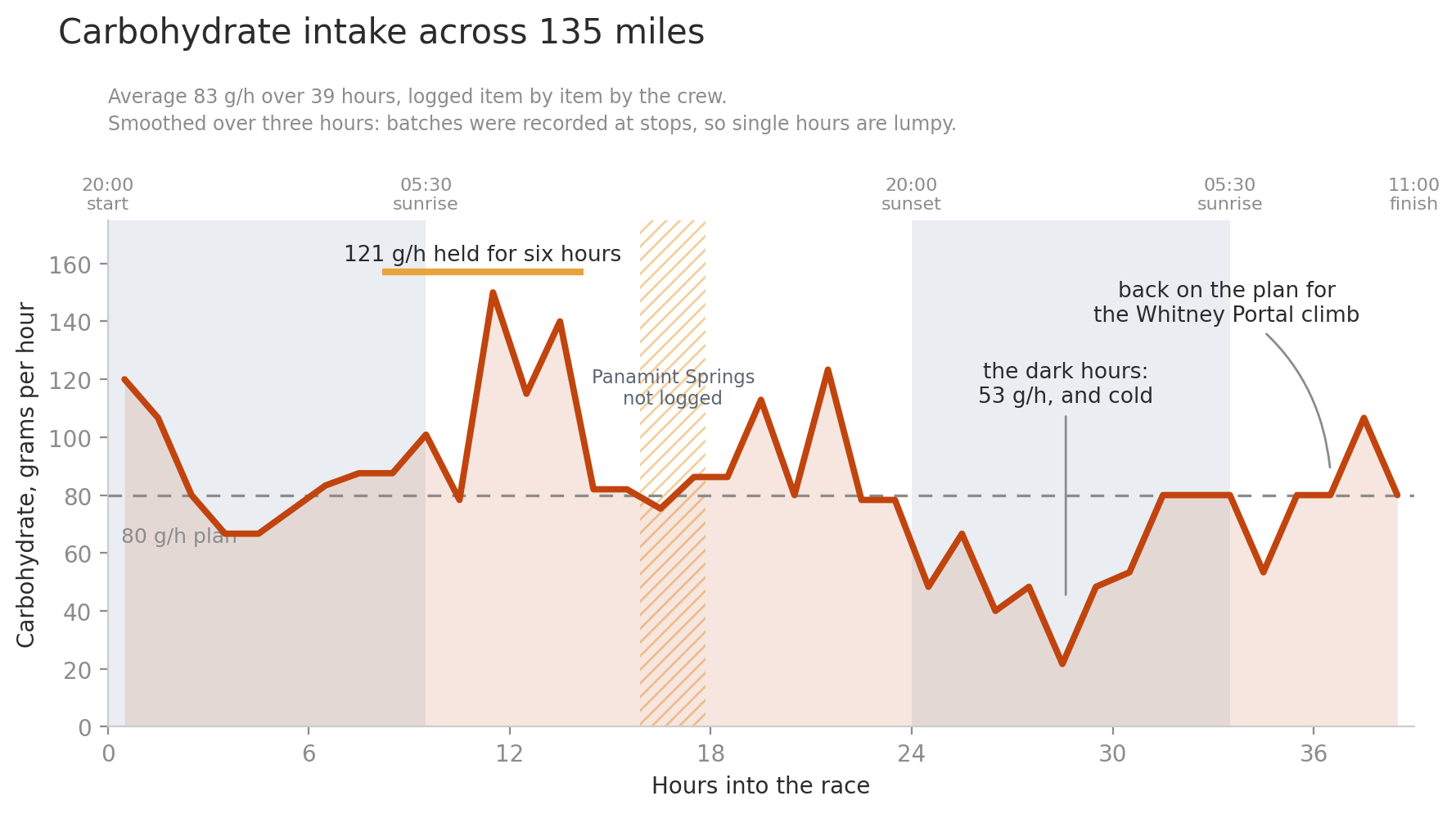
Carbohydrate intake per hour across the 39 hours
I hit 120g an hour without knowing it.
The 83g average is dragged down by the back half of the race. From about four in the morning through to ten, out of Stovepipe Wells and up over Townes Pass, I averaged 121g an hour for six hours straight, and 104g an hour across a full twelve. So the number I have been treating as an ambitious target for next time is a number I have already sustained, on a climb, with the temperature rising.
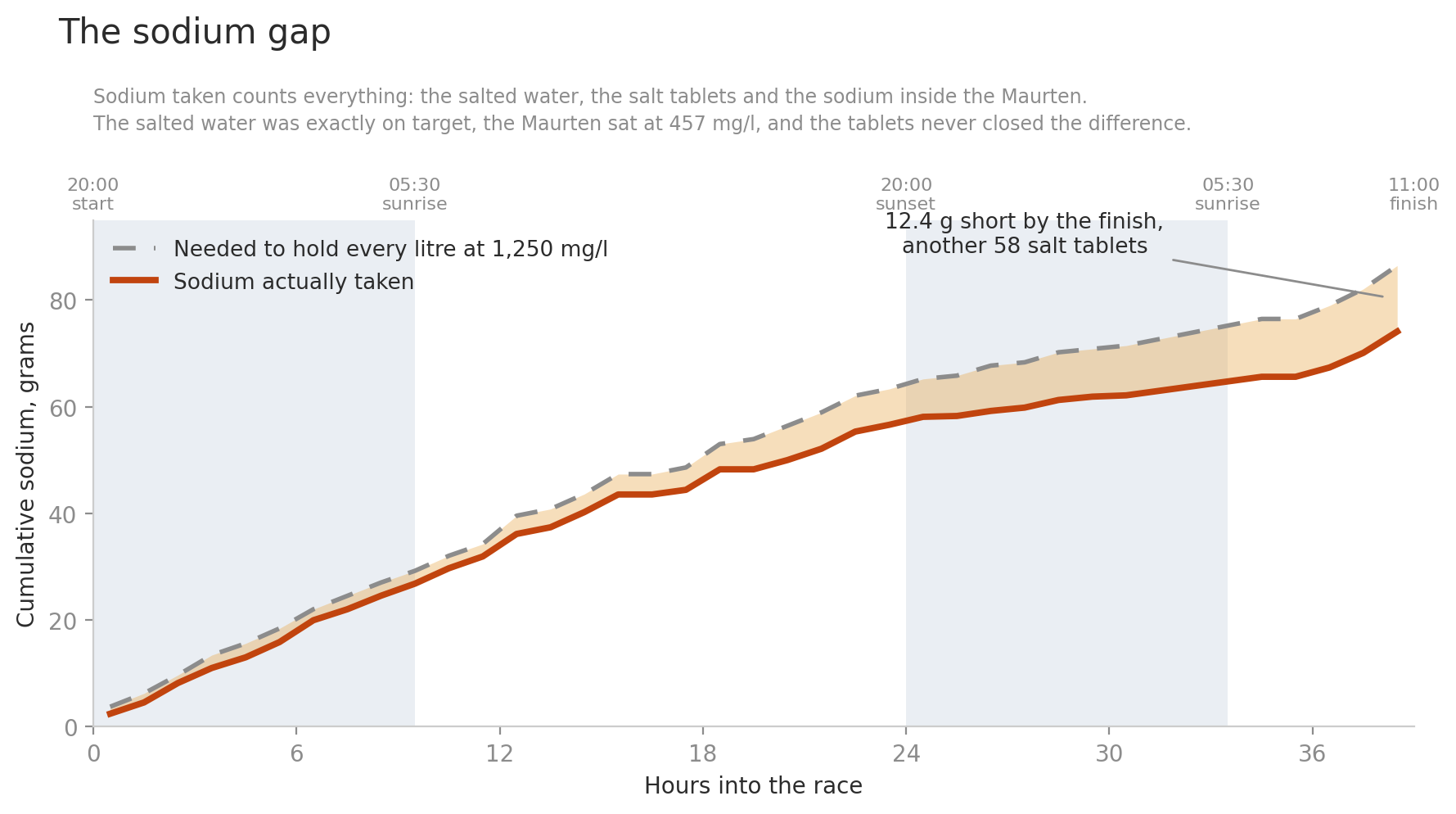
Cumulative sodium taken against the 1,250mg/l requirement
I didn't actually hit 1250mg/l.
The salted water was bang on, every bottle. But Maurten carries its own sodium at a much lower concentration, around 457mg/l across everything I drank of it, and the salt tablets we added alongside were meant to close that gap. Twenty four tablets went in. Holding the full 69 litres at 1250mg/l would have taken more like eighty. Across the whole race the fluid I drank averaged 1071mg/l, so I was running about 14% under my own protocol and I never felt it. Either the target was conservative, or the margin is wider than I assumed. Next time the tablets go on the same clock as the bottles rather than sitting there as a top-up.
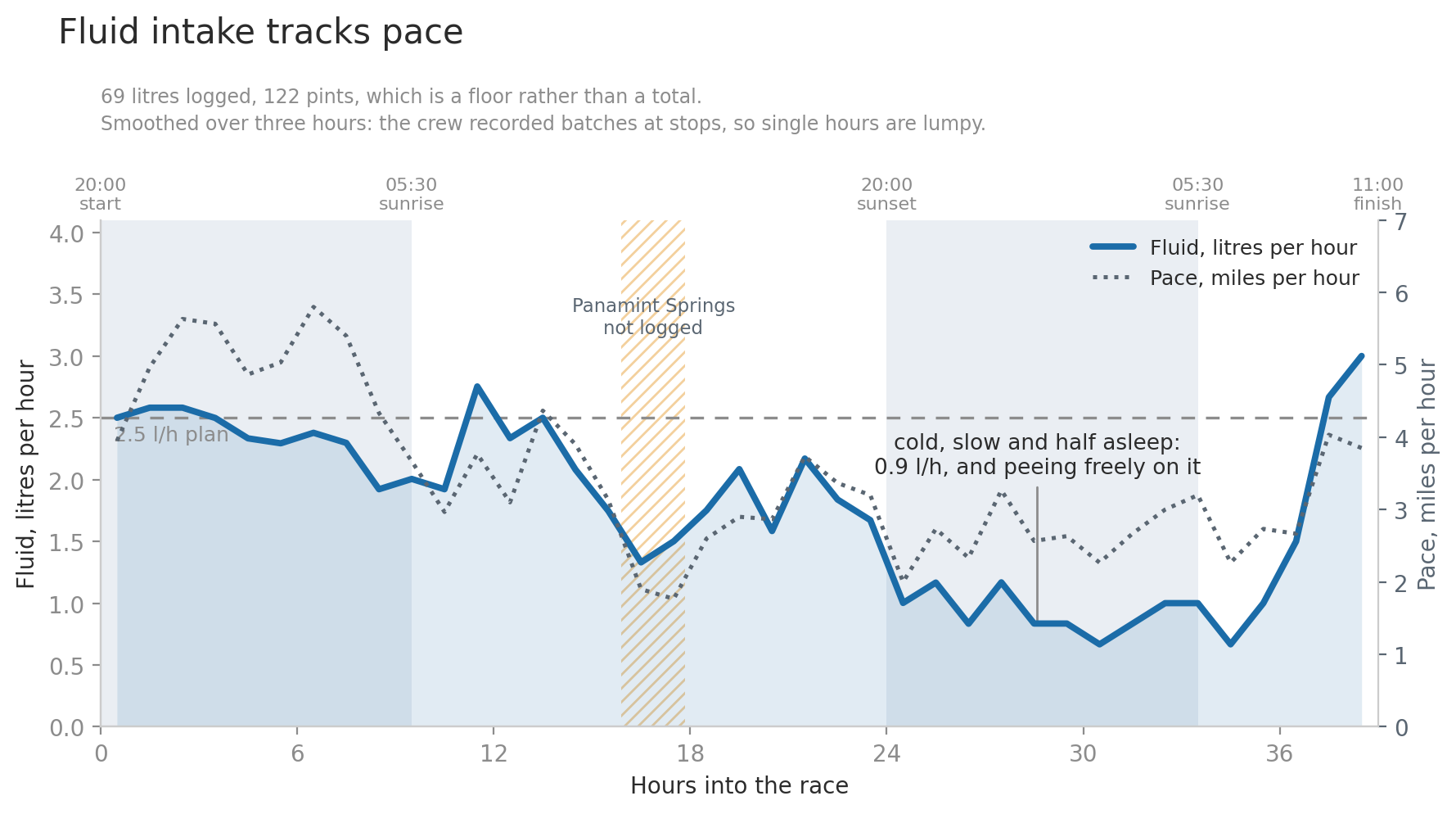
Fluid intake and pace across the 39 hours
Fluid tracked pace almost exactly.
Put the two lines on the same chart and they rise and fall together, with a correlation of 0.77 across the race. That sounds obvious written down, but it is the answer to something that puzzled me for weeks. Through the second night I was down to 0.9 litres an hour, the lowest of the whole race, and that is precisely when I was peeing most freely. It looked like a contradiction. It isn't. My pace had gone from just under five miles an hour on the first night to 2.7 miles an hour on the second. I was barely sweating by then. The intake was low, but the losses were lower, and the balance tipped the other way without me noticing.
The log has a hole in it, and it is worth highlighting that. There are 116 minutes at Panamint Springs with nothing recorded at all. That was the stop where the french fries happened and Brad taped my feet up for a second time. There was fluid taken there and it never made it onto the sheet, which is exactly what you would expect from a crew who at that moment had better things to do than write things down. So 69 litres is a floor rather than a total, and anything the chart appears to say about the middle of the second day should be read with that gap in mind.
There is one more thing in the log that isn't about me at all. Twenty one items were handed over and came back untouched, sixteen of them water bottles, nearly all of them in the first twenty four hours. The crew were offering more than I was taking, constantly, and writing down every time I said no. That is the job - they were excetpional!
The second night
Every line on every chart bottoms out in the same nine hours. Carbohydrate down to 53g an hour. Fluid down to 0.9 litres. Pace down to 2.7 miles an hour. Three separate measures, all falling away together between sunset and sunrise on the second day.
That is the stretch I wrote about in the race blog. The dark hours. Falling asleep on my feet while still walking. Brad alongside me saying nothing at all for hours, which turned out to be exactly the right thing to do.
I hadn't expected the fuelling data to describe any of that, but it does, and the cold is a bigger part of it than I realised at the time. Everybody assumes Death Valley is purely a problem of heat, and for most of the race it is, but the early morning up at altitude was genuinely cold. Cold does two things at once. It blunts your thirst, so you stop wanting the bottle. It also pushes your body to shed fluid rather than hold onto it, which is why I was peeing more freely than at any point in the race while drinking less than at any point in the race. Add a pace slow enough that I had almost stopped sweating and the whole picture resolves. I wasn't dehydrated out there. I was cold, slow and asleep, and my body was behaving exactly as you would expect.
The honest conclusion is that we had a plan for the heat and no plan for the cold. Nobody wrote a night protocol, so what happened overnight was a taper by accident rather than by design.
What did I actually eat?
Not much. A bit of mango. Some french fries at Panamint Springs while Brad taped my feet up for another time, and a decent amount of fluid there too, none of which anybody wrote down. A few handfuls of cashews. A flat Coca-Cola somewhere around fifteen hours in. That is more or less the list. My lasting memory of 39 hours of fuelling is the crew saying "here's a 320". They treated me to a few flavoured ones towards the end, but not until I had been going for about 35 hours.
What would I do differently?
More carbohydrate per hour. Since the race I have done a carbohydrate uptake test, which measures how many grams an hour your body actually absorbs, and it says I should be comfortable at 120g. The race data says I have already been there. Carbs are the most readily available fuel and they hold off the onset of muscle fatigue, which is something I have suffered with. Getting that 120g to hold for the whole race rather than six hours of it is the job for Nove Colli.
On hydration I was really happy with the process. Simple and cheap: salt and water. There is something quite amusing about turning up to an ultra with a box of Maldon sea salt. Two changes. The sodium bookkeeping, because salted water plus Maurten does not equal salted water, and the tablets need to be scheduled rather than sprinkled in. And a night protocol, with its own targets, written down before the race rather than discovered afterwards in a spreadsheet.
In ultras you have to keep it simple. At Badwater the crew did the thinking for me. They tracked it, measured it, and handed it over. If I am racing on my own the same formula works: get the right amount of carbohydrate in, 120g an hour, and make sure everything else you drink carries the sodium you are losing.